

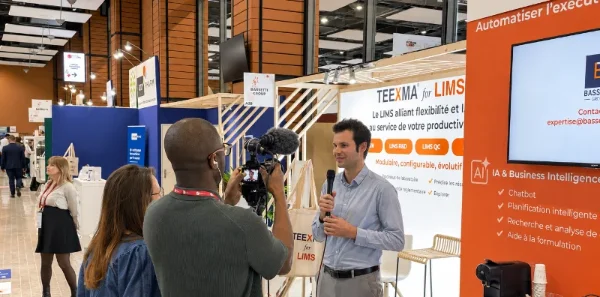
Hello William, to get straight to the point, we have been hearing about AI everywhere for several years now. What has really changed between the early days and today, especially for laboratories?
Hello, indeed, since the democratization of the first consumer tools at the end of 2022, artificial intelligence has become omnipresent.
In concrete terms, at first, AI was a very theoretical concept, often presented as a miracle solution or a magic tool, without clearly identified use cases or tangible returns on investment.
Today, we are in a phase of maturity, particularly in laboratories. The initial observation remains the same: laboratories have a considerable amount of data that they struggle to capitalize on. AI is a new tool to address this challenge, provided that the data is structured, qualified, and tied to very clear business use cases.
I have already heard you say that AI is useless without quality data. In concrete terms, what does that mean? And do you have examples of the use cases you mentioned?
Between software, equipment, spreadsheets, and paper, laboratory data is highly scattered and heterogeneous. Yet without reliable, up-to-date, and contextualized information, no artificial intelligence can produce relevant results.
This is in fact the major challenge on which we support our clients through our TEEXMA for LIMS product: digitizing, centralizing, and structuring their data so they have a foundation ready to be used by both humans and AI for specific use cases.
And to give a few examples of the features we will present at Forum Labo 2027: we offer intelligent planning to optimize scheduling and resource management, formulation assistance in R&D to predict the best ingredient combinations under constraints, and our Analysis and Prediction feature to model large volumes of data in order to identify similarities or detect anomalies.
Recently, Europe laid the first foundations of a regulatory framework for the use of artificial intelligence with the entry into force of the AI Act. What does this imply for laboratories?
The European AI Act strengthens requirements for transparency, traceability, and governance. For laboratories, this regulation involves two major areas. First, proper framing of day-to-day use: it is essential to train teams, define the boundaries of use, and ensure constant human oversight. AI remains a decision-support tool, but the human expert always retains final control. The second area concerns the choice of solutions they equip themselves with: laboratories must adopt software that is fully compliant with these standards.
To learn more:
Discover the page dedicated to LIMS

