
The explanation is simple: the air heated by the flame rises and carries with it the particles present around the burner. This would create a kind of protective zone, called an “aseptic dome” or “sterility dome,” in which the risk of contamination would be reduced.
This idea has been taught to microbiologists for generations. However, ISO 7218, the standard dedicated to microbiological analysis in the food chain, does mention the use of the Bunsen burner to sterilize loops and metal wires, but makes no reference to a sterile zone around the flame.
So, does this famous aseptic dome really exist? That is what a collaborative study set out to verify.
A collective experiment conducted in 126 laboratories
In 2026, the SuperMicrobiologistes website organized a study involving 126 microbiology laboratories around the world. The objective was to verify whether a lit Bunsen burner actually helped reduce airborne contamination. To do this, the laboratories carried out a very simple experiment: leaving Petri dishes open on a bench and observing whether they became more contaminated when the Bunsen burner was off or on.
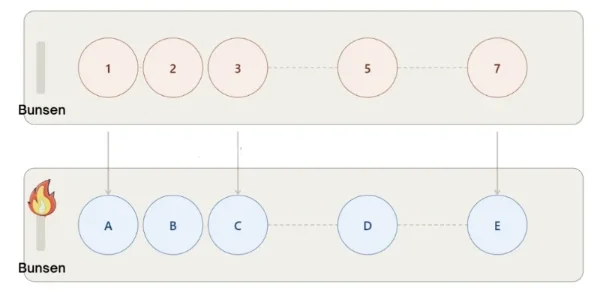
Each laboratory placed five Petri dishes containing a culture medium at different distances from the burner: 9, 18, 27, 45, and 63 cm. The dishes were first left open for 30 minutes with the burner off. The experiment was then repeated in the same place, on the same day, with five new dishes, but this time with the burner on.
The dishes were then placed in an incubator at 30 °C for three to five days. During this time, the microorganisms that had settled on the culture media were able to multiply and form colonies visible to the naked eye. All that remained was to count these colonies and compare the contamination observed with and without the Bunsen burner.
Result: the Bunsen burner does not appear to protect against airborne contamination
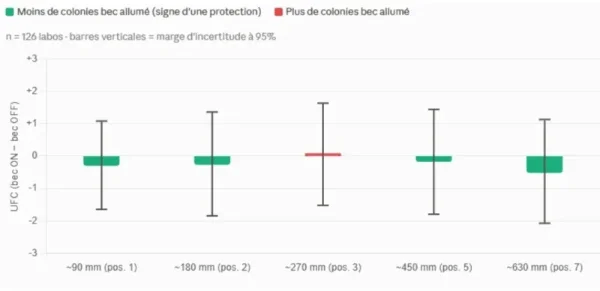
The results from the 126 laboratories are quite clear: no protective effect of the Bunsen burner could be demonstrated, regardless of the distance tested.
In some laboratories, the dishes placed near the lit burner showed fewer colonies. In others, they showed more. But when the results from all laboratories are combined, the differences are very small. In other words, lighting the Bunsen burner did not significantly reduce contamination, even on dishes placed only 9 cm from the burner.
The statistical analyses confirming these results are available in the full study.